




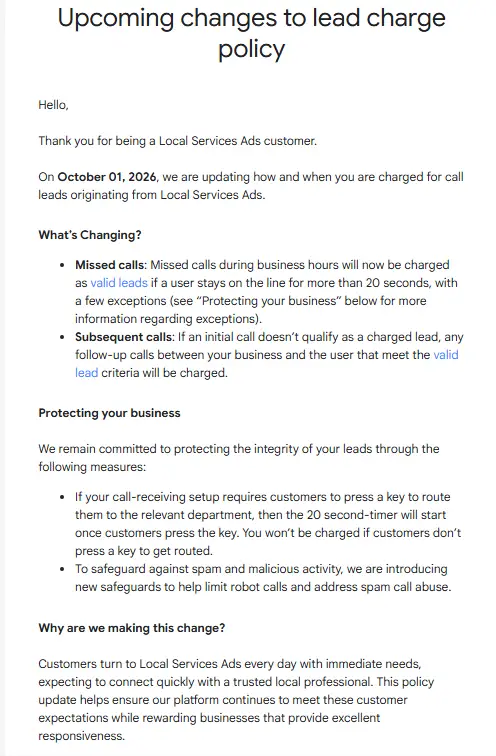
Google has notified Local Services Ads advertisers that its call lead charging policy changes on October 1, 2026. The headline change: a missed call during your listed business hours will now be charged as a valid lead if the caller stays on the line for more than 20 seconds.
Read that again. You do not have to answer the phone to pay for the call.
For most pool companies, LSA is the highest-intent lead source in the account, and the phone is the whole product. A homeowner with a green pool or a dead pump calls, someone answers, a job gets booked. This policy update takes the one metric most pool operations quietly struggle with, answer rate, and converts it from a ranking factor into a billing event. If your phones go unanswered while your techs are on route, you are about to start paying for silence. Here is what changed, why it lands harder on pool companies than most verticals, and what to fix in the next five weeks. If you want this handled rather than explained, this is exactly the kind of account protection built into how we manage Local Services Ads for pool companies.
What Google Actually Announced
First, missed calls become chargeable. If a call comes in during your stated business hours and the caller remains on the line for more than 20 seconds, Google will bill it as a valid lead whether or not anyone picks up. Until now, an unanswered call was generally not a charged event. After October 1, it is.
Second, subsequent calls close the loophole. If an initial call does not qualify as a charged lead, any follow-up call between your business and that user that does meet the valid lead criteria will be charged. Letting a call ring out and calling the number back no longer avoids the charge. It just moves it.
Google also outlined two protections. If your phone setup requires callers to press a key to route to a department, the 20-second timer starts when the key is pressed, and you are not charged if the caller never presses one. And Google says it is adding safeguards against robocalls and spam call abuse, which have historically been the biggest source of junk LSA charges.
Google’s stated rationale is that LSA customers have immediate needs and the platform should keep “rewarding businesses that provide excellent responsiveness.” Translated out of policy language: Google is done subsidizing advertisers who let the phone ring.
Why This Hits Pool Companies Harder Than Most LSA Verticals
A locksmith answers his own phone from the truck. A pool company running three routes has techs elbow-deep in filter housings from 7am to 4pm, an owner who is also quoting a remodel, and a phone that rings hardest in exactly the months when everyone is slammed.
That structure is why answer rate is the chronic weak point in pool company LSA accounts. It has always cost you ranking, because Google factors response behavior into which advertisers get the top spots. What it has not done, until now, is cost you cash directly on every missed connection. After October 1, a Saturday afternoon call from a homeowner staring at a green pool, ringing to voicemail after 25 seconds, is a billed lead you never spoke to.
Seasonality compounds it. The policy charges missed calls during your listed business hours, and most pool companies set those hours generously to capture demand. Wide hours with narrow answering capacity is now a configuration that generates charges by design.
The Core Shift: Answer Rate Is Now a Billing Event
Here is the change in one paragraph. Before October 1, 2026, a missed LSA call cost a pool company opportunity and ranking position. After October 1, a missed call during business hours that runs past 20 seconds costs the same as an answered one. Answer rate no longer just influences how often you appear in the top three. It directly determines your effective cost per conversation, because every missed billable call raises the real price of every lead you actually work.
That framing matters for how you evaluate the channel. Cost per lead was always the wrong metric for LSA. Cost per booked job was the right one. This policy widens the gap between the two for any account with an answering problem, and it does so silently, inside a dashboard number most owners never decompose.
Five Moves to Make Before October 1
- Audit your listed business hours against your actual answering capacity. Pull your LSA profile hours and put them next to your real coverage. If nobody reliably answers after 5pm or on Sundays, tighten the hours. An after-hours caller who cannot reach you was rarely converting anyway; after October 1, that call bills you. Hours are now a cost control, not just a visibility setting.
- Fix coverage, not just settings. Tightening hours protects the budget but shrinks the funnel. The better answer is making sure a human picks up: a dedicated phone owner during peak season, overflow routing to a second line, or a trained answering service for the hours your office is dark. The 20-second threshold is short. Whatever picks up needs to pick up fast.
- Rethink your phone tree with the key-press rule in mind. The timer on routed calls starts at the key press, and unrouted calls are not charged. A simple menu in front of your LSA line is now a legitimate spam filter, because robocalls and misdials rarely press keys. Keep it to one prompt. A homeowner with an emergency will press 1 for service; they will not sit through four options.
- Log everything for disputes, including callbacks. The subsequent-call rule means your return calls can trigger charges, so your call log is now billing evidence. Track every LSA call with timestamps, duration, and outcome, and keep your dispute cadence weekly. Google is promising new spam safeguards, but safeguards are automated and disputes are not. The operators who contest junk charges inside the window are the ones whose cost per booked job survives this change.
- Re-baseline your numbers now, not in November. Record your current answer rate, charged lead count, and cost per booked job for September. When the October invoice looks different, you want to know exactly how much of the change is the policy and how much is your operation. Without a September baseline, you will be arguing with a dashboard instead of managing a channel.
What This Signals About Where LSA Is Going
This is not an isolated tweak. Google retired the Money Back Guarantee and moved advertisers to the Google Verified badge, and it is folding LSA management into the Google Ads interface. We covered what the move into Google Ads means for your LSA account when that was announced, and this charging change fits the same pattern: LSA is maturing from a lead-gen side program into a standard Google ad product, with standard Google expectations. The platform is being rebuilt to reward operational excellence and bill for its absence.
That is bad news for pool companies treating LSA as a set-and-forget vending machine. It is genuinely good news for the ones who answer fast, dispute rigorously, and run their profile like an asset, because every policy in this direction thins out the competition above them. Your response behavior already feeds your ranking, your reviews already feed your badge, and the Google Business Profile playbook for pool companies still underpins all of it. The operators who take that stack seriously are about to get paid for it twice: better positions and cleaner invoices.
Final Thoughts
Google just put a price on every ring that goes unanswered. For pool companies, where the phone is the business and the busy season is exactly when coverage breaks down, this is the most operationally consequential LSA change since the program launched. The configuration fixes take an afternoon. The coverage fix takes a decision. Both need to happen before October 1, because after that, the invoice makes the decision for you.
We manage Local Services Ads for pool service companies across the country, one client per territory, and account protection like this is a standing part of the engagement, not a reaction to a news cycle.
Want to know what this policy will actually cost your account? Book a free Marketing Audit and we will pull your answer rate, your charged lead history, and your real cost per booked job, and show you exactly what to fix before the new billing starts.