



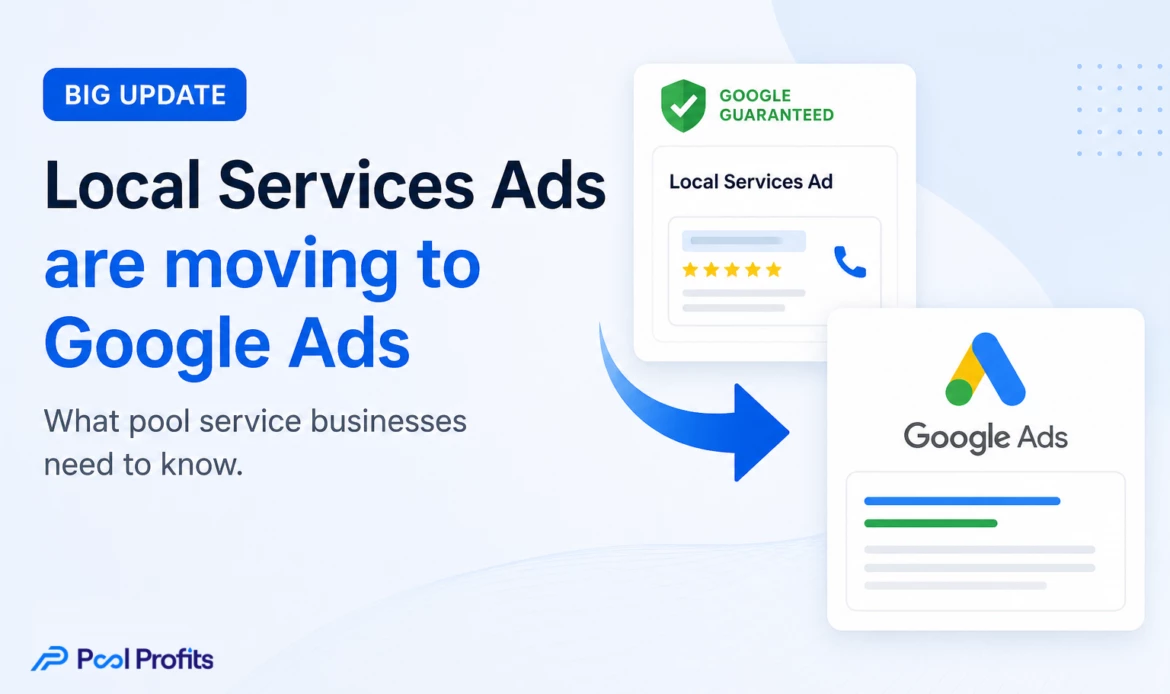
Google is retiring the standalone Local Services Ads dashboard. Starting with a phased rollout in early August 2026, LSA campaigns will move into the main Google Ads interface as a new campaign type Google calls Performance Max for pay-per-lead goals, with the migration continuing in waves through 2027. Google announced the change in its Ads documentation, and Search Engine Land covered the rollout details on July 20.
For pool companies, this lands close to home. The first migration wave covers a small group of US advertisers in pet care, home services, wellness, and education, and pool service sits squarely inside the home services bucket. Whether your account moves in August or next spring, you will get advance notice from Google, and there is one thing you need to do before that notice arrives. We will get to it in a moment, because it is the only part of this change with a real deadline.
Quick Answer
Local Services Ads are not changing how they work. They are changing where you manage them. Ads still appear only on Google Search and Maps, campaigns remain keywordless and driven by your Google Business Profile, and you still pay per valid lead rather than per click. What disappears is the separate LSA dashboard: campaigns, leads, and calls move into the Google Ads interface, your budgets and settings transfer automatically, and your historical LSA performance reports do not. Download your reporting history before your account migrates.
What Is Actually Changing, and What Is Not
Strip away the branding and this is a console consolidation, not a product change. The mechanics pool companies care about survive intact. Your Google Guaranteed badge, your pay-per-lead billing, your Search and Maps placements, and the ranking system built on reviews, responsiveness, and proximity all carry over. Despite the Performance Max name, Google states these campaigns do not expand onto YouTube, Display, or any other channel. If a rep or a dashboard recommendation ever suggests otherwise, that would be a different campaign type wearing a similar name, and it deserves the same scrutiny as any upsell.
Two things are genuinely new. First, centralized management: LSA lives in the same interface as your search campaigns, so budgets, leads, and calls sit beside the rest of your paid program instead of in a separate login your office manager checks twice a month. Second, real-time Google Business Profile syncing: edits to your GBP, including business details and photos, now flow into your ad campaigns automatically.
That second one deserves more attention than it is getting.
GBP Syncing Cuts Both Ways
Automatic syncing sounds like a maintenance win, and for well-run profiles it is. But understand what it means structurally: your Google Business Profile is now the single source of truth feeding your paid campaigns. The wrong holiday hours, an outdated service list, a photo a tech uploaded from a half-finished job, all of it can now propagate into ads you are paying for, automatically, without anyone touching the ad account.
Pool companies have historically treated GBP as a set-and-forget asset. That was already costing map pack rankings. After migration, it also puts your pay-per-lead spend downstream of profile hygiene. The companies that keep GBP actively managed, current photos, accurate services, correct hours by season, get a compounding benefit: one edit updates everything. The companies that do not will be advertising their neglect.
The One Deadline: Download Your LSA History Now
Google has confirmed that budgets, settings, and creative assets transfer automatically, but historical performance reports will not migrate into Google Ads. Google is telling advertisers to export past reporting data before their accounts transition.
For most industries that is an inconvenience. For pool companies it is a real loss if you miss it, because our industry runs on seasonal comparison. What did a lead cost last April versus last October? How did booking rates shift between startup season and closing season? Which weeks does demand actually turn in your market? That year-over-year seasonal baseline is how intelligent LSA budgets get set, and once your account migrates, the record is gone. Export everything: lead reports, charge history, booking data, by month, going back as far as the dashboard allows. It is twenty minutes of work that preserves years of pricing intelligence. Do it this week, not when the migration email arrives.
What Unified Management Changes for Your Budget
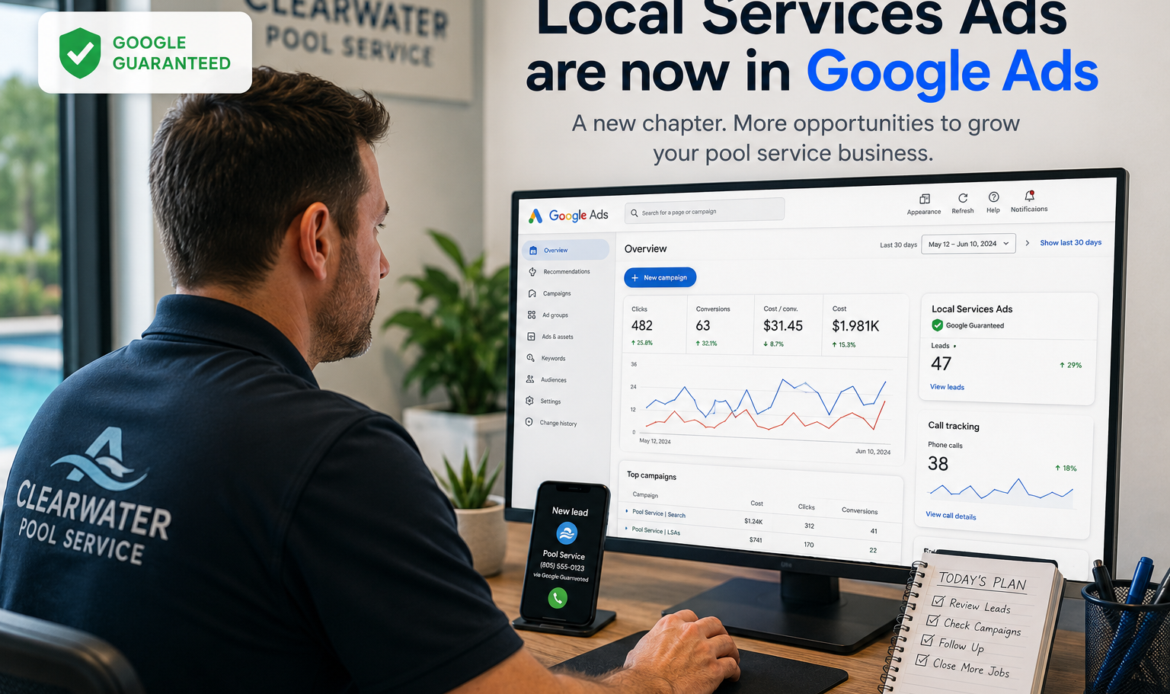
Moving LSA into Google Ads is genuinely convenient, and convenience in an ad platform is never free. Inside the main interface, LSA spend now sits next to automated recommendations, optimization scores, and the same nudges that quietly inflate search budgets when nobody is watching. The consolidation makes cross-channel management easier for disciplined operators and easier to overspend for everyone else.
The discipline that made LSA profitable does not change with the interface. Rank still responds to review velocity and answer speed more than bids. Invalid leads still need to be disputed inside the window or you pay for them. Budgets still need seasonal weighting rather than a flat number. What changes is that all of it now happens in one console, which means your search campaigns and your pay-per-lead campaigns can finally share data and oversight in one place. Run well, that is an upgrade. Run passively, it is a bigger bill with better branding.
The Pool Company Migration Checklist
The rollout is phased through 2027 and Google will notify you before your account moves, so nothing here is a panic item. Everything here is a this-quarter item.
- Export your full LSA reporting history now: leads, charges, and booking data by month. This is the only irreversible step.
- Audit your Google Business Profile like it feeds your ad spend, because it is about to: hours, services, service areas, categories, and photos.
- Document your current LSA settings, budgets, and service selections so you can verify the automatic transfer landed correctly.
- Confirm who owns your Google Ads login and that LSA management access maps cleanly, especially if different people or vendors have historically handled the two dashboards.
- Recheck your dispute routine after migration, since the workflow will live in a new place and skipped disputes are quiet overspend.
- Watch the first post-migration billing cycle closely and compare cost per lead against the history you exported.
The Bottom Line for Pool Companies
This migration will produce the same split every platform change produces. Companies with managed accounts will export their history, verify the transfer, tighten their GBP, and come out the other side with a cleaner operation in one console. Companies running LSA on autopilot will lose their seasonal data, inherit whatever their neglected profile syncs into their ads, and notice the difference on an invoice months later.
If you are not sure which side of that line your account is on, that is exactly what the free Marketing Audit is for. We will pull up your LSA standing, your Google Ads account, and your Google Business Profile in the same session and show you what migration-ready looks like for your market.